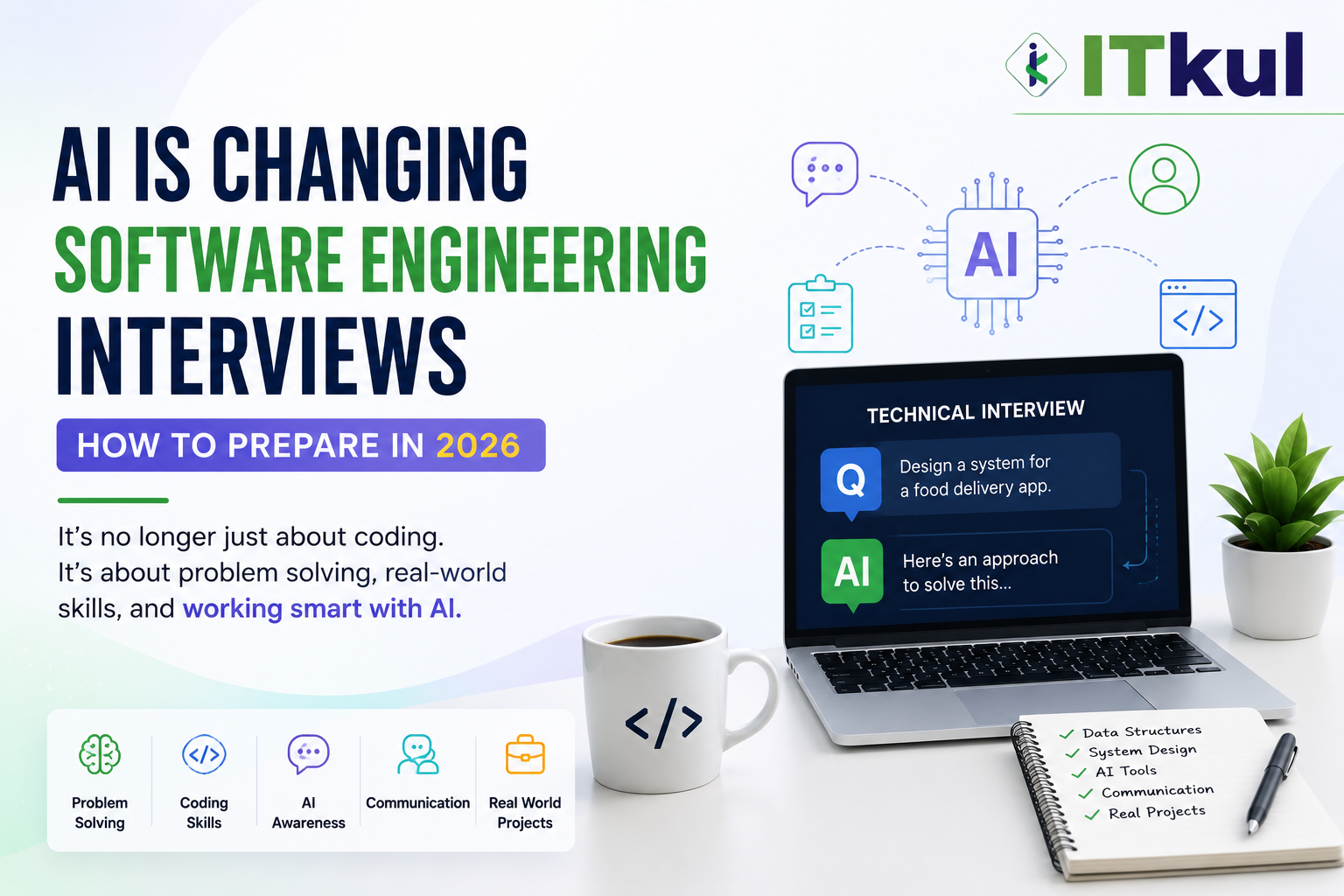
AI Is Changing Software Engineering Interviews: Here's How You Can Prepare in 2026
- Tech News & Research
- ITKul Team
- February 17, 2026
- 0 Comments
Technical interviews are evolving in the AI era. Learn what software companies expect in 2026, why AI skills matter, and how students can prepare for successful software engineering careers.
The software engineering hiring process is evolving rapidly as Artificial Intelligence becomes an integral part of software development. Companies are no longer evaluating candidates solely on their ability to solve coding problems or memorize algorithms. Instead, employers increasingly seek professionals who can think critically, build real-world applications, collaborate effectively with AI tools, and solve business problems.
Modern software teams now use AI coding assistants to improve productivity, automate repetitive tasks, and accelerate development. As a result, technical interviews are shifting toward practical skills, AI-assisted development, project experience, and communication rather than traditional coding tests alone.
Technical Interviews Are Becoming More Practical
Traditional interviews often emphasized solving algorithm questions under strict time limits. While problem-solving remains important, companies increasingly assess candidates using project-based tasks, debugging exercises, system design discussions, and collaborative programming challenges.
Recruiters now evaluate whether candidates can build complete applications, explain technical decisions, review AI-generated code, optimize existing software, and communicate solutions effectively.
AI Is Becoming Part of the Interview Process
Many organizations recognize that software engineers already use AI tools in their daily work. Rather than banning AI, employers now focus on how responsibly candidates use these tools while maintaining code quality and engineering best practices.
Developers are expected to write effective prompts, validate AI-generated code, identify security issues, improve generated solutions, and explain implementation decisions with confidence.
What Employers Expect from Software Engineers in 2026
Programming Fundamentals: Strong knowledge of Python, Java, SQL, JavaScript, Data Structures, and Algorithms remains essential.
AI-Assisted Development: Experience using ChatGPT, GitHub Copilot, Cursor AI, Microsoft Copilot, and other AI coding assistants responsibly.
Practical Projects: A portfolio containing Full Stack applications, REST APIs, cloud deployments, and GitHub repositories demonstrates real-world capability.
System Design Skills: Employers value candidates who can design scalable architectures, optimize applications, and solve business problems.
Communication: Explaining technical decisions clearly and collaborating effectively within development teams has become a highly valued skill.
Your GitHub Portfolio Matters More Than Ever
Recruiters increasingly review GitHub profiles before scheduling interviews. Well-documented repositories, meaningful commits, clean coding practices, and practical projects help candidates demonstrate their software engineering abilities beyond a traditional resume.
Students should build projects such as Full Stack web applications, REST APIs, AI-powered applications, cloud-hosted systems, automation scripts, dashboards, and database-driven software solutions.
Essential Skills Every Software Engineer Should Learn
Future-ready developers should combine strong programming knowledge with modern AI-assisted development skills. High-demand technologies include Python, Java, SQL, Git & GitHub, REST APIs, Docker, Kubernetes, AWS, Microsoft Azure, Prompt Engineering, System Design, Software Testing, and Cloud Computing.
Learning these technologies through hands-on projects and practical assignments significantly improves employability.
How Students Can Prepare
Instead of memorizing interview questions, students should focus on building complete applications, contributing to GitHub, practicing coding challenges, participating in hackathons, and learning how to work effectively with AI coding assistants.
Mock interviews, open-source contributions, and continuous learning help improve technical confidence, communication skills, and real-world problem-solving ability.
Conclusion
Artificial Intelligence is transforming software engineering interviews, but it is not replacing technical expertise. Employers continue to value professionals who understand programming fundamentals, build practical projects, communicate effectively, and use AI responsibly to develop high-quality software.
At ITKul, our industry-focused training programs in Full Stack Development, Python, Java, Artificial Intelligence, Cloud Computing, Software Testing, Data Science, and Generative AI help students build practical, industry-ready skills aligned with modern software engineering hiring practices.
ITKul Team
ITKul Team is delivering expert articles, technology insights, and career resources focused on AI, Data Science, Software Development, Cloud, Cyber Security, emerging IT trends and Tech news to help learners become industry-ready professionals.

Leave a Comment